








Ink & Printer Compatibility
The printers that print PrestoTex
A practical compatibility guide for wallcovering brands, print shops, and print on demand businesses sourcing printable wallcovering substrate. Learn which printers and ink chemistries run cleanly on PrestoTex, covering eco-solvent, latex, UV, and water-based resin platforms across every major manufacturer.
Compatible with the equipment you already own. Qualified across 40+ production printer models from HP, Epson, Roland, Mimaki, Mutoh, Canon, swissQprint, EFI, Vanguard, Agfa, and Durst.
The compatibility question
BUILT TO RUN ACROSS FIVE INK CHEMISTRIES.
Wallcovering printing has consolidated around five ink chemistries: latex, UV, eco-solvent, water-based resin, and solvent. Each one has its own production logic, but the substrate underneath should not be the variable that decides which printer you can buy. PrestoTex is engineered to run cleanly across all five, so the chemistry you choose is the one your business actually needs.
The five ink chemistries
Ink chemistry at a glance.
Each chemistry has a different curing mechanism, durability profile, and odor level. Understanding which one matches your production environment matters as much as which printer you buy.
Property - Comparison
LatexHP · Ricoh
Compatibility
PrestoTex CompatibilityRecommended
Where You'll See ItWallpaper brands, hospitality, residential
Performance
Cure MethodHeat (in-line)
OdorVery low
LaminationImmediate
Scratch ResistanceGood to excellent
Indoor Air QualityExcellent
Market Position
Industry DirectionDominant in wallcovering
Property - Comparison
UVMulti-brand
Compatibility
PrestoTex CompatibilityRecommended
Where You'll See ItPrint shops, mixed substrates, exterior
Performance
Cure MethodUV light (instant)
OdorLow to none
LaminationImmediate
Scratch ResistanceExcellent
Indoor Air QualityExcellent
Market Position
Industry DirectionFastest growing
Property - Comparison
Eco-SolventRoland · Mimaki · Mutoh · Epson S
Compatibility
PrestoTex CompatibilityRecommended
Where You'll See ItSign shops, designer studios
Performance
Cure MethodAir dry with heat
OdorMild
LaminationAfter outgassing
Scratch ResistanceGood
Indoor Air QualityGood with ventilation
Market Position
Industry DirectionMature, stable
Property - Comparison
SolventLegacy platforms
Compatibility
PrestoTex CompatibilityCompatible
Where You'll See ItEstablished print operations, vehicle wraps
Performance
Cure MethodAir dry with heat
OdorStrong
LaminationExtended outgassing
Scratch ResistanceGood
Indoor Air QualityIndustrial ventilation
Market Position
Industry DirectionIn service, not pushed for new equipment
Property - Comparison
ResinEpson R Series
Compatibility
PrestoTex CompatibilityCompatible
Where You'll See ItProduction shops, sensitive environments
Performance
Cure MethodHeat (in-line)
OdorVery low
LaminationImmediate
Scratch ResistanceExcellent
Indoor Air QualityExcellent
Market Position
Industry DirectionEmerging alternative
Latex, UV, and resin all deliver low-odor, instant-dry, durable output suited to commercial wallcovering. Eco-solvent remains a fully viable platform. Solvent equipment remains in service across many shops, though it is no longer pushed by manufacturers as a new equipment investment.

Chemistry in plain language
What each ink actually is
The compatibility chart above tells you how each chemistry behaves. This section tells you what each one is, how it cures, and which printers run it. It’s useful if you’re evaluating a platform you don’t already operate.
01 Recommended/ LatexHP · Ricoh
The dominant ink chemistry for residential and commercial wallcovering production today. Latex inks combine pigment with a polymer binder in a water carrier; heat from the printer evaporates the water and fuses the polymer to the substrate.
Printer models
- HP Latex 700, 800, 800W
- HP Latex 560, 570
- HP Latex 315, 335, 365
- Ricoh Pro L Series
02 Recommended/ UVMulti-Brand Roll-to-Roll
The fastest-growing platform in wide format printing. UV inks contain photo-initiators that cure instantly when exposed to UV light, producing a fully cross-linked, durable ink film that bonds aggressively to a wide range of substrates.
Printer models
- Mimaki UJV, UCJV
- Roland VersaUV LEC2, IU
- swissQprint Karibu
- Canon Colorado (UVgel)
- EFI VUTEk Q, h, Pro
- Vanguard VK Series
- Agfa Anapurna
- Epson SureColor V7000, V4000
- Durst UV
03 Reccomended/ Eco-SolventRoland · Mimaki · Mutoh · Epson
Eco-solvent uses a milder solvent carrier than legacy solvent inks, with significantly reduced odor and lower VOC output. It’s still widely used in established print shops, smaller sign and graphics shops, and production environments without industrial ventilation.
Printer models
- Roland TrueVIS VG, SG, BN
- Roland VersaCAMM
- Mimaki JV100, JV300, JV330
- Mutoh ValueJet
- Epson SureColor S Series
04 Compatible/ SolventLegacy roll-to-roll platforms
Solvent platforms remain in service across many established print shops, particularly for vehicle wraps and fleet graphics. The chemistry uses an aggressive solvent carrier that bonds well to a wide range of substrates. Solvent is no longer being pushed by manufacturers as a new equipment investment due to indoor air quality and regulatory factors, but if you already own and operate solvent equipment, PrestoTex runs on it.
Printer models
- Roland SolJet (legacy)
- Mimaki JV solvent (legacy)
- Mutoh Spitfire (legacy)
- Seiko I solvent platforms
05 Compatible/ ResinEpson SureColor R Series
Epson’s water-based resin platform sits in its own classification, between latex and traditional eco-solvent. The chemistry is water-based and pigmented like latex, but uses a different binding agent that helps the pigments form a scratch-resistant film on the substrate.
Printer models
- Epson SureColor R5070
- Epson SureColor R5070L
- Epson SureColor R5000
- Epson SureColor R5000L
The full matrix
Printer compatibility by manufacturer
The table below covers every major wide-format roll-to-roll platform qualified for printable wallcovering substrates. PrestoTex has been validated across each platform through internal testing, customer field reports, or both.
If you operate a printer or ink set not listed here, contact our team. We can usually provide a media profile or arrange a sample for qualification testing.
LatexInk type
- Manufacturer
- HP
- Model / Series
- Latex 300, 500, 700, 800 Series
- Notes
- Recommended. The dominant platform in wallcovering production. Full PrestoTex compatibility across all four generations.
- Manufacturer
- Ricoh
- Model / Series
- Pro L Latex Systems
- Notes
- Compatible. Less common in wallcovering but works well on PrestoTex when properly profiled.
UVInk type
- Manufacturer
- Epson
- Model / Series
- SureColor V7000, V4000
- Notes
- Compatible. Roll-to-roll UV with strong output on coated wallcovering substrates.
- Manufacturer
- Roland DG
- Model / Series
- VersaUV LEC2, IU Series
- Notes
- Compatible. Strong scratch resistance on PrestoTex.
- Manufacturer
- Mimaki
- Model / Series
- UJV Series, UCJV Series
- Notes
- Compatible. Popular in mixed-substrate production environments.
- Manufacturer
- EFI / VUTEk
- Model / Series
- VUTEk Q, h, Pro Series Roll-to-Roll
- Notes
- Compatible. Industrial-class UV for high-volume wallcovering production.
- Manufacturer
- swissQprint
- Model / Series
- Karibu (roll-to-roll)
- Notes
- Compatible. Premium Swiss-built UV platform suited to commercial wallcovering work.
- Manufacturer
- Vanguard
- Model / Series
- VK Series UV Roll-to-Roll
- Notes
- Compatible. Strong fit for production shops scaling into wallcovering.
- Manufacturer
- Agfa
- Model / Series
- Anapurna Series
- Notes
- Compatible. Common in commercial print operations adding wall graphics.
- Manufacturer
- Durst
- Model / Series
- UV Roll-to-Roll Platforms
- Notes
- Compatible. Validated for PrestoTex production.
UVgelInk type
- Manufacturer
- Canon
- Model / Series
- Colorado M Series
- Notes
- Compatible. Canon’s UVgel platform performs well on PrestoTex with available media profiles.
Eco-SolventInk type
- Manufacturer
- Epson
- Model / Series
- SureColor S Series (S40600, S60600, S80600)
- Notes
- Compatible. Widely used in print shops with strong color gamut on PrestoTex.
- Manufacturer
- Roland DG
- Model / Series
- TrueVIS Series, VersaCAMM Series
- Notes
- Compatible. Common in design studios and small print shops.
- Manufacturer
- Mimaki
- Model / Series
- JV100, JV300, JV330 Series
- Notes
- Compatible. ES3 and BS4 ink sets both qualified.
- Manufacturer
- Mutoh
- Model / Series
- ValueJet Series
- Notes
- Compatible. Mature platform with broad print shop installed base.
SolventInk type
- Manufacturer
- Legacy Platforms
- Model / Series
- Older Roland, Mimaki, Mutoh, Seiko I solvent printers
- Notes
- Compatible. If you operate legacy solvent equipment. Solvent is no longer pushed for new equipment investment due to regulatory and indoor air quality factors, but PrestoTex still runs cleanly on it.
ResinInk type
- Manufacturer
- Epson
- Model / Series
- SureColor R5070, R5070L, R5000, R5000L
- Notes
- Recommended. Epson’s water-based aqueous resin platform, designed for wallpaper, fabric, and uncoated paper applications.
Where the industry is going
UV is leading growth. Latex still owns wallpaper. The category is consolidating around four chemistries
Across the wide format industry, the new equipment investment is concentrated in latex, UV, and the smaller but growing water-based resin category, with eco-solvent holding steady as the entry-level platform for shops not ready to step up to latex or UV. The five-chemistry landscape is real, but it’s not balanced: most production shops scaling into wallcovering today are choosing between two or three of these, not all five.
Whichever direction you go, PrestoTex is engineered to run on it.


If you’re buying new equipment
What we suggest, and why
If you already own a printer, the choice is essentially made. PrestoTex was designed to work with the equipment you have. If you’re buying new, here’s where each chemistry tends to land best, based on what we see across our customer base.
Indoor air quality matters for residential and trade installs. Latex is the chemistry most established in the wallcovering category, with the broadest media support, instant lamination, and proven longevity in residential environments. Most established wallpaper brands print on it.
Suggested: Latex (HP 700 or 800 Series)
Print shops typically run mixed substrates and benefit from the speed and substrate flexibility of UV. Instant cure removes the outgassing step from the workflow, which matters when wallcovering is one of several categories sharing the same equipment.
Suggested: UV (swissQprint, Mimaki UCJV, EFI VUTEk)
POD operations optimize for throughput and color consistency across long runs. Both latex and UV deliver instant lamination, which matters most when shipping within 48 hours of order. The choice between them often comes down to whether you also produce non-wallcovering categories.
Suggested: Latex or UV (HP 700/800, Mimaki UCJV)
Studios doing custom one-of-one or short-run wallcovering often start with eco-solvent. It’s a lower equipment investment, mature platform, and broad service network. The right entry point before production volume justifies stepping up to latex or UV.
Suggested: Eco-Solvent (Roland TrueVIS, Epson S Series)
Frequently asked
Questions about printer compatibility
The questions that come up most often when wallpaper brands, print shops, POD businesses, and designers are evaluating PrestoTex for production. If you don’t see your question, our team is happy to talk through specifics on your equipment.
Is PrestoTex compatible with my specific printer model?
PrestoTex has been qualified across HP Latex, Ricoh latex, all major eco-solvent platforms (Roland, Mimaki, Mutoh, Epson), all major UV platforms (Mimaki, Roland, swissQprint, Canon, EFI VUTEk, Vanguard, Agfa, Durst, Epson V Series), and the Epson SureColor R Series resin platform. If your printer is one of these or runs the same ink chemistry, you’re covered. If you have a less common platform, contact us with the model and ink chemistry and we can usually confirm compatibility quickly.
Do you provide ICC profiles or media presets?
Yes. We maintain media profiles for the most common production printer and ink combinations. If you let us know your specific equipment, we can either send the existing profile or work with you to develop one. Most customers find the existing profiles get them within tuning range of optimal output, with minor adjustments for their specific RIP and shop conditions.
Which ink type is best for wallcovering production?
For most wallcovering brands selling residential and commercial product, latex remains the safest equipment choice. The combination of indoor air quality, immediate lamination, and proven longevity in residential installs is hard to beat. UV is the right answer for print shops running mixed work. Epson’s resin platform is a sensible alternative for shops already in the Epson ecosystem.
Will the metallic substrate look the same with every ink type?
No, and this is something to test before production. PrestoTex’s Silver and Gold Iridescent metallic substrates show through the printed ink wherever coverage is light, which is part of what makes the metallic versions interesting. Different inks interact with that effect differently. Latex and resin sit on the surface and let more of the metallic ground show through. UV produces a more opaque, graphic result. We recommend ordering metallic samples specifically when evaluating, since the visual difference is significant.
Can I use white ink or a clear overcoat on PrestoTex?
Yes, on printers that offer those features. White ink is supported on platforms like HP Latex 700W and 800W, Mimaki UCJV, and Roland VersaUV. This is particularly useful with the metallic substrates, where white ink can selectively block the metallic ground in areas you want to read as solid color. Clear overcoats (gloss, matte, or varnish) on UV platforms are also fully compatible and can be used as a finishing layer on top of the print.
Can I use PrestoTex with aqueous (water-based) ink?
No. PrestoTex is not compatible with traditional aqueous wide format printers (the dye and pigment ink platforms used for fine art, photography, and proofing). The substrate is engineered for the four production wallcovering chemistries (latex, UV, eco-solvent, and water-based resin) plus solvent for legacy equipment. If you’re running an aqueous wide format printer and want to print wallcovering, you’ll need to step into one of those production platforms.
How long is the outgassing period before I can laminate?
It depends on the chemistry. Latex, UV, and resin all support immediate lamination, which means there is no outgassing wait. Eco-solvent typically needs 12 to 24 hours of outgassing before lamination, depending on ink lay-down and shop conditions. Solvent platforms generally need an extended outgassing period beyond eco-solvent. PrestoTex behaves consistently across these timelines, so the constraint comes from the ink, not the substrate.
How can I get samples to test on my equipment?
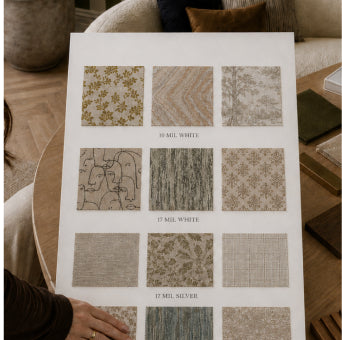
Swatch books are available by request and feature all of our thickness and color options including White, Silver, and Gold Iridescent so you can see and feel the substrates in person. For printing on your own equipment, we recommend testing with sample rolls, which are available to order with free shipping.
Continue reading
Related resources
The technical and commercial documentation that pairs with this compatibility guide. Each is built for a specific moment in evaluating PrestoTex for production.


Follow us
@PRESTOTEX